Johnny is sitting in his seat and somebody else’s.
If you’re a business owner, I imagine you can relate.
He’s tired. He was just starting to thrive in his Integrator role, and then a key leadership team member left. It usually ends up being a good and necessary change, but it can be painful in the middle.
How about you?
Maybe someone left and hasn’t been backfilled. Maybe the role never existed and the business grew into needing it. Maybe you know exactly who you need to hire and the revenue isn’t quite there yet to justify it.
So you’re carrying both. And you’ve been telling yourself it’s temporary for about seven months now.
This is one of the most common things I see with integrators, operators, and sometimes CEOs. Wearing multiple hats as a leader isn’t a badge of honor. It’s a survival window. The goal isn’t to be heroic in it. The goal is to get through it without wrecking yourself, and to come out the other side with a great hire in that seat.
Here’s how to do that.
You’re in the Penalty Kill
In hockey, when your team takes a penalty, you play a man down for two minutes.
And here’s what’s interesting: the team doesn’t panic, and they don’t play harder. They play differently.
For the most part, they stop trying to score. They back into a tighter formation. They dump the puck down the ice instead of trying to make beautiful passes. And they change lines constantly, thirty or forty seconds at a time, because a tired player is often how you give up a goal.
Nobody watches a penalty kill and says the team is underperforming. Everyone understands: they’re shorthanded, it’s temporary, and the objective changed.
You don’t win the game on the penalty kill. You survive it, and you don’t take another penalty while you’re there.
That’s your situation. You’re shorthanded. The objective has changed. And a mistake people make in this season is trying to play their normal game with fewer players on the ice.
So let’s change the game.
Nine Ways to Play the Kill
Stay Healthy. Pick Two.
You can’t work if you’re sick. You definitely can’t work if you’re dead.
I know the full wellness routine isn’t happening right now. Six a.m. gym, meal prep, eight hours of sleep, meditation. Maybe that seems impossible at the moment.
Fine. Pick two things and protect them like they’re client meetings.
One physical, one relational is a good rule. Everything healthy is spiritual, so don’t overthink that part. Walk during your calls. Dinner with your family four nights a week, phone in another room. That’s it. Two things you stay ruthlessly committed to.
Two things you actually do beats ten things you feel guilty about. And when this season ends, you want to still have your health and the people who matter most to you. How you handle pressure is a leadership skill, not a personality trait.
Simplify Both Seats
Go through each seat and ask: what actually has to happen here?
Not what’s happened in the past. What has to happen. There is work in both of those roles that exists because someone started doing it in 2019 and nobody ever stopped.
Cut it. Simplify the processes that stay. Three approval steps become one. The weekly report becomes monthly. The thing you do because it’s nice becomes the thing you skip until Q1.
And here’s the part most people won’t do: decide on purpose which seat gets your A game and which one gets B level work.
You cannot do two jobs excellently. You can do one excellently and one adequately. If you don’t choose deliberately, you’ll do both at seventy percent and feel terrible about all of it. Pick. Then let the B work be B work without the guilt and shame.
Delegate. Actually Delegate.
Everybody thinks they understand delegation. Most people are bad at it.
Forwarding an email with “can you take this?” is not delegating. That’s transferring a task and hoping. And when it comes back wrong, you conclude you can’t delegate, when what actually happened is you never set anyone up to succeed.
Real delegation follows a progression: I do it, you watch. Then we do it together. Then you do it, I watch. Then it’s yours.
That takes more time up front than just doing it yourself. That’s exactly why people skip it, and exactly why they’re still doing it themselves a year later.
And delegation isn’t just handing over the work. It’s handing over the authority to make calls about the work. If they have to check with you on every decision, you didn’t delegate. You added a step. This is the whole reason developing your leaders matters as much as fixing the org chart.
Ask for Favors
You’re carrying extra weight. Who else can pick some of it up for a few months?
Here’s something worth knowing about people: they will say yes to almost anything if it’s clearly temporary and clearly defined.
“Would you own the vendor calls for the next ninety days while we get someone in that seat?” gets a yes far more often than a vague request for help. People will take on work they don’t even like when they know when it ends and they know it matters.
Most leaders in this spot don’t ask. They white knuckle it because asking feels like admitting they can’t handle it.
Asking for help in a shorthanded season isn’t weakness. It’s line changes.
Fewer Meetings, More Stand Up Conversations
Keep the Level 10. Keep the two or three meetings that genuinely drive the business. Say no to nearly everything else, and say it plainly.
But here’s the trap: if you disappear into your calendar to survive, your people feel abandoned right when they need you most.
So walk around with your head up. Take the sixty second hallway conversations. They’re worth more than most meetings anyway.
“I can’t do a meeting this week, but tell me right now, what’s the number one thing getting in your way?”
That’s sixty seconds. And it does something a scheduled meeting often doesn’t: it tells that person they matter to you, and it surfaces the obstacle while it’s still small.
Fewer meetings. More moments. You can breathe life into people in a hallway.
Keep Momentum
Momentum is the thing you protect at all costs in this season, because rebuilding it costs ten times more than maintaining it.
Start meetings on time. End on time. Even when, especially when, you’re slammed. The rhythm is what tells everyone the wheels are still on.
Stay on your Rocks. You may need to cut the number of them. Cut them. But don’t quietly abandon them, because the moment priorities go fuzzy, everything becomes equally urgent and nothing moves.
And watch your high performers closely. If one of them gets stuck waiting on you for a decision, that’s the most expensive thing happening in your company that week. Unblock them first, before almost anything else on your list.
Buy Time
You’re saving the business real money by sitting in two seats. Spend a little of it on yourself.
A recruiter, so the search is actually happening while you’re heads down. A trainer, so the health thing takes decisions off your plate. A house cleaner. Grocery delivery. A coach, so you have one place to think out loud.
Owners and operators in this season are often weirdly reluctant to spend money on relief, while burning something far more expensive: themselves.
If a thousand dollars a month buys back a day and keeps you sharp, that’s not an indulgence. That’s the cheapest thing on your P&L.
Put an Expiration Date on It
A season without an end date isn’t a season. It’s your new life.
So name it. “I am in both seats through March 31.” Write it down. Tell the leadership team, tell your significant other.
Then make the hire an actual Rock with an actual date, tracked like anything else that matters. Not “we’ll hire when we can afford it,” because that day arrives and passes silently, and you’ll still be here next winter.
Set the trigger in advance: at this revenue number, or on this date, whichever comes first, we post the role. Decide it now, while you can still think clearly.
Because here’s what happens otherwise. You get good at carrying two seats. Everyone adjusts. The pain becomes normal, and the business quietly reorganizes itself around your exhaustion. That’s how owners end up prisoners in their own business.
Document the Seat While You’re Sitting in It
You are, right now, the world’s leading expert on what that second role actually requires. Nobody has better data than you.
So capture it as you go. Keep a running doc. Every time you do something in that seat, note it. What you did, how long it took, what it required, what a great outcome looks like.
Ninety days of that and you have the real job description, the scorecard, the first thirty days of onboarding, and a clear picture of what to screen for.
Two things happen. Your hire gets dramatically better, because you stop hiring a vague title and start hiring against reality. And the onboarding takes weeks instead of months, because the playbook is better defined.
It turns the worst part of this season into the most valuable asset that comes out of it.
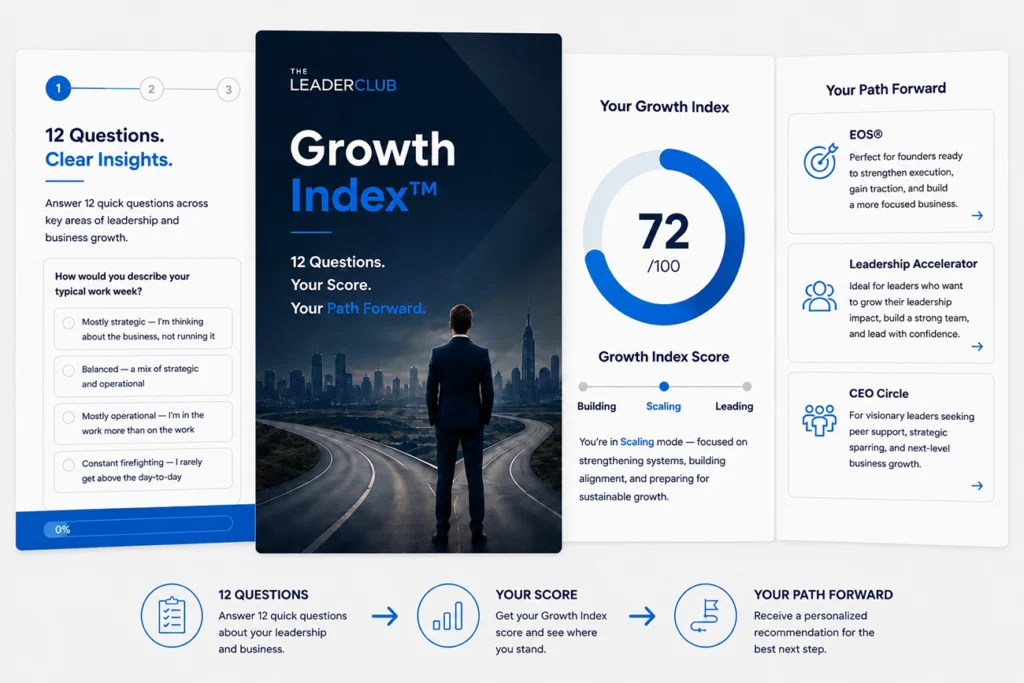
The Founder Growth Index™ tells you which gear needs work.
Scored across multiple dimensions, it shows you exactly where your business is constrained and where to focus first.
The Season Ends
If you’re in this right now, you’re likely doing better than you think you are. People in two seats grade themselves against what they’d do with full capacity, and then feel like they’re failing at both.
You’re not failing. You’re shorthanded. Those are completely different things, and you should stop confusing them.
Play the kill. Protect your health, protect your momentum, protect your people. Get the hire made.
And then get off the ice and go breathe.
So here’s the question worth answering today:
What’s the actual date this season ends, and what has to be true for that date to be real?
If you can’t answer that, that’s the first thing to fix this week.
More on this: making space to think and reset · what EOS® actually is · work with Caleb as an EOS Implementer · all resources
Still carrying two seats?
Let’s talk about what it takes to get someone in that chair, and how to protect yourself until they arrive.