There’s a moment every growing business hits.
Revenue is up. The team is bigger. From the outside it looks like things are working. But from where you sit, you can hear it rattling. The handoffs that drop. The customer issue that only got caught because someone happened to notice. The fact that four separate things this week required you personally, or they wouldn’t have happened.
Duct tape and twine. Held together by heroics, mostly yours.
So you do the right thing. You put in structure. Maybe you bring in EOS: accountability chart, scorecard, rocks, Level 10s. Good call. That’s genuinely the correct first move.
Six months later, you’re wondering why EOS isn’t working the way you were promised. The meetings happen. The scorecard is mostly green. And you are still the bottleneck.
Here’s what I’ve learned coaching owners through exactly this: the system was never the whole answer. It’s one of three parts. And almost everyone stops after the first one.
Hand a High School Team the Chiefs’ Playbook
Imagine you gave a high school football team the complete playbook of a championship NFL franchise.
Every formation. Every read. Every audible. The exact system that wins at the highest level of the sport.
What happens Friday night?
They get destroyed. Not because the playbook is wrong. The playbook is excellent. But the playbook was never the thing that made that team great.
The plays only work if the players have the skill to execute them. And the skill only shows up under pressure if the team believes it belongs on that field.
The playbook is necessary, and not sufficient alone.
That’s the whole article, honestly. Systems, skills, and psychology. None of them is optional.
Many owners install the playbook and then wonder why they’re still losing games.
Part One: Systems
Let me be clear, because I don’t want this misread as a knock on EOS. It isn’t.
Structure is the correct first move, and I think EOS is the best version of it. When a business outgrows the founder’s ability to hold everything personally, you need a system that makes the business go beyond the point person.
Clear accountability, so two people stop assuming the other one has it. A scorecard that tells you the truth without you digging for it. Rocks, so priorities are named instead of implied. A meeting rhythm that produces decisions instead of discussion.
That’s real. That’s necessary. If you don’t have it, get it. That’s your next ninety days. Implement EOS, and I can help you with that.
But here’s what structure does and doesn’t do.
Structure reveals problems. It does not solve them.
Your scorecard will show you that a number is red. It will not develop the leader who owns that number. Your accountability chart will show you that a seat is weak. It will not build the person sitting in it.
Which brings us to the part most owners skip entirely.
Part Two: Skills
Here’s the thing nobody says out loud when the new system goes in.
It’s the same people implementing it.
Same team. Same capabilities. Same habits they had last quarter. You changed the operating system. You didn’t change the operators. And now you’re asking them to do things they have genuinely never been trained to do.
- Run a meeting that produces decisions.
- Hold a peer accountable without it getting weird.
- Have a direct conversation with someone who reports to them.
- Own a number instead of owning a task list.
Nobody taught them any of that. Including you.
And this is where I see owners get frustrated in a way that’s understandable but not fair. You figured it out. Nobody handed you a leadership curriculum. You learned by getting punched in the face for fifteen years and paying attention.
But you have to see the difference. You had the highest possible motivation to learn: it was your name, your money, your risk. You had permission to make expensive mistakes because they were your mistakes to make. You had a decade.
Your ops leader has none of that. They were hired to do a job well, and they’ve done it well, which is exactly why you promoted them. Now you’re asking them to be something different, and the assumption is they’ll absorb it by proximity.
It’s tough to make that transition without coaching.
Skill development is a real thing that requires real investment. Coaching. Feedback that’s specific enough to act on. Reps in a setting where failing is survivable. Someone showing them what good looks like, more than once.
Skip it and here’s what happens: the system exposes their gaps, they feel exposed, they get defensive or they get quiet, and you conclude you’ve got the wrong people. Sometimes that’s true. Usually you’ve got untrained people and a system that just turned the lights on.
Part Three: Psychology
Systems first. Skills second. But neither one holds without the third, and psychology isn’t a phase you get to later. It has to be woven through the whole thing.
Because underneath the org chart, three identity shifts have to happen. And they’re harder than anything on the scorecard.
Your psychology: from player to coach
You built this by being the best player on the field. Fastest, most capable, most willing to do whatever it took. It’s that grit that got you here. But I don’t want you to think it’s your identity.
The best player and the best coach are different jobs. The player wins by performing. The coach wins by developing people who perform, which means watching someone do it at seventy percent of your speed and not ripping the ball away from them.
There’s a deeper layer here too, and it’s the one that actually stops people.
For a lot of owners, the business isn’t something they own. It’s who they are. Which makes stepping back feel like disappearing, like becoming less. So they find reasons to stay essential, and every reason sounds operational.
Until you separate your identity from your involvement, you will unconsciously protect your own indispensability, or your need to be at the center of everything. And no system survives that.
Their psychology: from doer to leader
Your key people have their own shift to make.
They were promoted for being great doers. Their whole sense of value comes from output: from being the one who handles it, who knows the answer, who stays late and gets it done.
Now you want them to lead. Which means their output goes down and their team’s output goes up. That feels, on the inside, like becoming less valuable.
They need to hear directly from you that the job changed. Not implied. Stated plainly. Otherwise they’ll keep doing the work they know is valuable while quietly hoping the leadership part sorts itself out.
And a lot of them are waiting for something else too: a real signal that you’ll actually let go. They’ve watched you take things back before. They’re not going to fully step up until they believe you’ll stay stepped back.
The organization: from family to high-performance team
This is the one that stings, so let me be careful with it.
Most businesses that grow past a few million started as a family. Loyalty ran both ways. Nobody got let go over a bad year. People got carried because they’d been there since the beginning and everyone remembered what they did in 2018.
That culture is real and it built something, for a season. But this is a new season and something else will be required.
A high-performance team is not colder than a family. Done right, it’s warmer, because the care is paired with honesty.
Family says: you’re in regardless. High-performance team says: you’re valued, you’re developed, you’re told the truth, and the standard is the standard.
The shift isn’t caring less about people. It’s caring enough to be honest with them.
Most owners resist this because they think it means becoming ruthless. It doesn’t. It means the person who’s been coasting for two years finally gets told, which is more respectful than another year of everyone knowing and nobody saying it.
Why the Order Matters
Systems, then skills, with psychology integrated throughout. That sequence.
Start with skills before systems and you’re developing people to operate inside chaos. Start with psychology before either and it’s a personal growth conversation with nothing structural to hang it on.
Systems
Make the gaps visible.
Skills
Close them.
Psychology
Lets people walk through both without protecting themselves the whole way.
Take any one out and it stalls. Systems alone: expensive structure that nobody fully runs. Systems plus skills, no psychology: capable people who still defer every real decision to you, because the identity work never happened, on either side.
All three together is what makes a business grow up.
The Honest Question
If you’ve put structure in place and it hasn’t delivered what you hoped, I’d push back on the most common conclusion.
It’s not that EOS doesn’t work. And it’s usually not that you have the wrong people.
It’s that you installed part one and expected all three.
So here’s what I’d sit with this week:
Which of the three are you actually missing: the system, the skills, or the psychology? And which one have you been avoiding because it’s the one that involves you?
Then, when you’re ready, let’s talk.
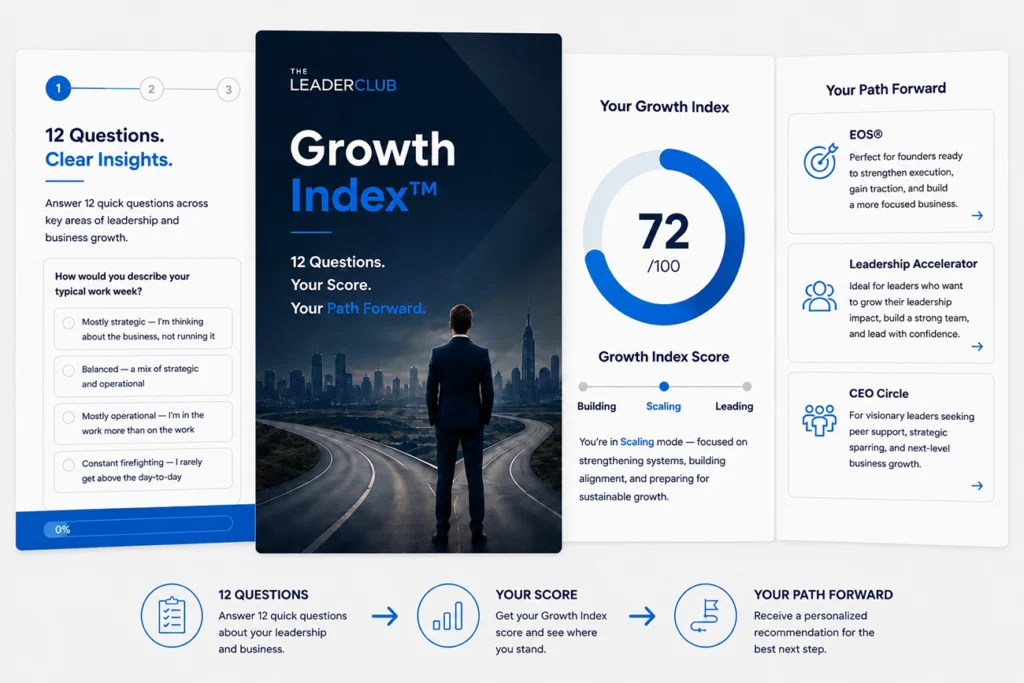
The Founder Growth Index™ tells you which gear needs work.
Scored across multiple dimensions, it shows you exactly where your business is constrained and where to focus first.
You’ve got the system. Let’s build the rest.
If the structure is in place and you’re ready for the skills and the psychology that make it actually work, that’s exactly what we do.